Deadline for Next Issue
2022-09-06

Sri Lanka Journal of Indigenous Medicine (SLJIM), published by Faculty of Indigenous Medicine, University of Colombo, visualize to prosper across the continents by providing a magnificent platform to publish original research reports in English in all areas of basic scientific and clinical research on Indigenous/ Traditional system of Medicine, Medicinal plants, Ayurvedic and Pharmaceutical science etc. Further the journal encourage the submission of papers relevant to multidisciplinary clinical studies on curative and preventive aspects, historical, literal, cultural, and socioeconomic perspectives. The journal also publishes invited review papers, book reviews and short communications. The submission of a manuscript will be taken to imply that the work is original, and it or a similar paper (other than an abstract) has not been, and will not be submitted elsewhere for publication. The Sri Lankan Journal of Indigenous Medicine (SLJIM) Peer-reviewed bi-annual research journal for publication free of charge.
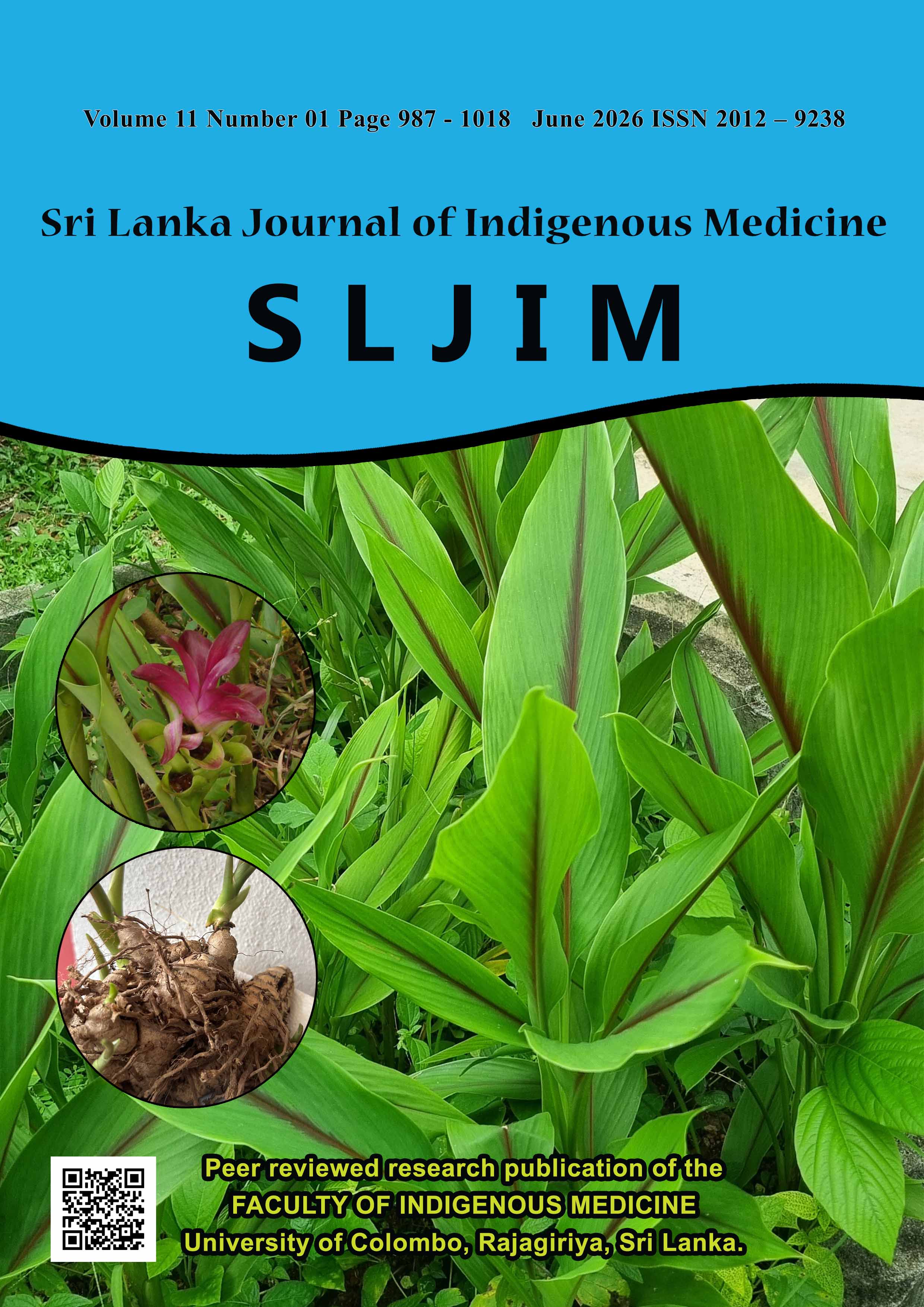
Cover story
Harankaha
Botanical name: Curcuma zedoaria (Christm.) Roscoe
Family: ZINGIBERACEAE
Vernacular names: Sinhala: Harankaha; Sanskrit: Shati; English:
Zedoary, White turmeric; Tamil: Karppurakkilangku, Manipuri,
Meitei yaingang; Hindi: Jangli haldi
Curcuma zedoaria Rosc. syn. C. zerumbet Roxb.) closely resembles turmeric (C. longa) in appearance. It is a native of northeast India and is widely cultivated in many parts of China, Sri Lanka, and India 1 .
Curcuma species are tropical crops used as cut flowers, landscape plants and speciality potted plants. Among this group, the beautiful inflorescence and luxurious foliage of C. zedoaria (Christm.) Roscoe (a traditional source of Zedoary spice, tonic, and perfume) has potential in floriculture. Zedoary is an herbaceous and rhizomatous perennial plant composed of an upright pseudostem, a corm (an ovate rhizome), underground cylindrical branches or rhizomes (that develop up to the third order when fully matured), and fleshy roots. Some roots develop terminal storage structures (rounded to elongate tuberlike roots called t-roots). Active axillary buds are on the lower side of the corm and branches. From March to April axillary buds of the corm and apical buds of the third order rhizomes emerge above ground as inflorescences 2 .
Various parts of this plant are used in Ayurveda and other folk medicines for the treatment of different ailments such as diarrhoea, cancer, flatulence and dyspepsia 3 . Various parts of plant have been reported for the presence of complex phytoconstituents which includecurcumin, ethyl p-methoxycinnamate, beta-turmerone,beta-eudesmol, zingiberene, dihydrocurcumin, furanodiene, alpha-phellandrene, 1-8 cineole, beta-elemene and germacrone 4 .
References
1. Wilson L., Spices and Flavoring Crops: Tubers and Roots, Encyclopedia of Food and Health 2016, Pages 93-97
2. Maciel N., Criley R.A., Morphology, growth and flowering behavior of Curcuma zedoaria, ISHS Acta Horticulturae 624: XXVI International Horticultural Congress: Elegant Science in
Floriculture
3. Lobo R., Prabhu K.S., Shirwaikar A., Shirwaikar A., Curcuma zedoaria Rosc. (white turmeric): a review of its chemical, pharmacological and ethnomedicinal properties, J Pharm Pharmacol, 2009 Jan;61(1):13-21
4. Shankar G., Sushmita I.H., Kagawad P., Jivaje K., Mahesh S.P., Shailendra S. Suryawanshi Curcuma zedoaria Rosc (Zingiberaceae): A review on its chemical, pharmacological and biological activities, Pharm Sci (2021) 7:166
Cover story by Prof. S.D. Hapuarachchi
Photographed by Mr. G.S.K. Perera
Cover page designed by Mr. K.K.P.R.K. Kohombakanda